
Brantley County Criminal Docket Searches
Start with the court, not the name. The Georgia Courts E-Access directory sends a Superior Court search to the provider listed for "Brantley Superior". It also flags the account requirement up front. That path reaches the main felony docket. Magistrate, Probate, Nahunta Municipal, and Hoboken Municipal records are a different story. Nothing there gets searched at the same time. A precise case number beats anything else. With only a name, use the authorized party-name field and narrow by court, year, or case class if the provider actually offers those filters.
Treat search results as leads, nothing more. The case header, the chronological event list, the settings, and the disposition each tell you something different. So read them as layers. No match? Check spelling, year, and court before concluding a record doesn't exist. Older files and restricted matters may need the clerk's direct help. So may paper that was never digitized. The Brantley County docket search walks through the fuller name-and-number workflow.
- Identify Superior, Magistrate, Probate, or the issuing municipal court.
- Use the exact case number, or an authorized name search if needed.
- Match the court, case type, and filing year before opening a result.
- Trace charges, settings, plea, disposition, sentence, and any appeal.
- Confirm the latest setting or order with the court that owns the file.
No Brantley State Court Docket
Brantley County has no State Court listed in its official directory. Plenty of Georgia counties do. So don't borrow another county's map and chase misdemeanor searches in a court that doesn't exist here. Instead, begin with the paper that started the case and whichever office currently holds it.
The county court directory gives contacts for Superior, Magistrate, and Probate. The official Brantley clerk profile shows that criminal and civil functions sit in separate hands within the Superior clerk's office. Felonies belong to Superior. Early warrant work may sit in Magistrate. Statutory misdemeanors and city matters stay with Probate or the municipal court that received them.
Brantley Criminal Docket Account Gate
Think of the state directory as a router, not one big public database. Choose Brantley Superior and you hit a provider account gate. The public state page never shows the provider's full search form. So don't assume filters that aren't there. PeachCourt documentation describes searching by county and court, then by exact case number or party name. It also notes that coverage in many courts reaches back about 2005. That's a general statement, not a Brantley promise.
The PeachCourt interface shows the filing and access system behind Brantley Superior work. It handles filings, but electronic filing never moves custody away from the clerk.

That page names the entry point. The official criminal case record, and any certified copy, still comes from the Brantley County Clerk of Superior Court.
Brantley Criminal Dockets: What They Show
A Brantley County criminal docket is a chronological index, nothing fancier. It usually names the court and case. It lists parties and attorneys, and it logs each filed event. Settings, pleas, dispositions, sentences, and appeal steps can appear there too. Copy the case number exactly as printed rather than guessing at a format. And remember this. A docket line can summarize an event without showing the document image behind it.
| Case Number | Clerk-assigned identifier, shown here only as exactly as printed because no public Brantley syntax was verified. |
|---|---|
| Charge(s) | Separate counts, current descriptions, and any public statute or classification fields. |
| Hearing Settings | Arraignment, calendar call, motions, plea, trial, or sentencing dates, including later resets. |
| Plea | The accused person’s formal response, which must be read apart from the final outcome. |
| Disposition | Dismissal, nolle prosequi, plea, verdict, or other outcome, followed separately by sentence when applicable. |
Brantley Disposed Is Not Convicted
"Disposed" tells you the court recorded an outcome. It doesn't tell you what the outcome was. One count may end in dismissal. Another may end through nolle prosequi, a guilty plea, a verdict, or some other lawful resolution. Read each charge on its own. Then find the plea or verdict and the sentence as separate events. Counts within a single Brantley County criminal docket often finish in different ways.
Dates deserve the same skepticism. A docket can preserve an old calendar call even after a reset. A filed motion is merely a request until an order resolves it. Bond information shifts quickly, so never read it as release advice. When you need formal proof, ask the custodian for a certified disposition. Or ask for a certified sentence instead of printing a screen.
Brantley Criminal Case Docket Stages
A Brantley criminal case often opens with a warrant or complaint and a first stop in Magistrate Court. Bond entries may follow. A Superior felony file then logs the accusation or indictment where applicable, arraignment and plea, motions, and calendar calls. A plea or trial produces the disposition. Sentencing and any post-judgment or appellate entries arrive later. The sequence shifts from case to case, so treat this outline as a reading aid, not a promised schedule.
Docket flow: Warrant or Complaint › Initial Hearing › Accusation or Indictment › Arraignment › Pretrial › Plea or Trial › Disposition › Sentence
A “calendar call” checks status and readiness. It is not always the trial itself. An indictment is a grand-jury charging instrument, while an accusation is the charging tool Georgia procedure allows in certain matters, and neither one equals a conviction.
Events can continue after a case is resolved. A sentence is a separate court order. Probation revocation, bond forfeiture, notice of appeal, record transmission, and remittitur can all add later docket lines, and remittitur simply means an appellate result returned to the trial court. Those entries can change what a final record looks like, so name the exact outcome document you need when you contact the clerk.
Suite 200 Criminal Record Help
Felony records for Brantley County Superior Court sit with the Clerk of Superior Court's criminal division at Suite 200, 234 Brantley Street, Nahunta, Georgia 31553. The office answers its phone at 912-462-5635. Staff can identify a file, tell you whether it is indexed electronically, and confirm whether an image or copy exists. Doors are open 8:00 a.m. to 5:00 p.m., Monday through Friday. Prefer mail? Send a specific written request to P.O. Box 1067, Nahunta, GA 31553. The fax number is 912-462-6247, but call first, since staff must confirm that faxing is accepted.
Give the court, the exact case number if you have it, the case style, the rough year, and the document you want. Say whether you need a plain or certified copy. Ask about current fees and how to pay, because Brantley's official sources publish no complete price sheet for case copies. One more option exists. GSCCCA notes that its covered databases can be used free of charge inside any Georgia Superior Court clerk's office.
Clerk of Superior Court
234 Brantley Street, Suite 200
Nahunta, GA 31553
912-462-5635
Brantley County Criminal Docket Courts
Brantley County Superior Court, in the Waycross Judicial Circuit, is where felony dockets live. Suite 300 houses Magistrate Court, which handles warrants, preliminary hearings, and other assigned criminal work. Probate Court holds the traffic and misdemeanor jurisdiction that Georgia law assigns it. Ordinance and traffic cases from inside the cities go elsewhere. They belong to the Nahunta and Hoboken Municipal Courts. Juvenile Court records carry special confidentiality rules, so treat them differently from the start.
Note that Brantley has no State Court listed in the official county directory. Routing a misdemeanor there will fail. Let the charge, the citation, and the initiating court decide whether Magistrate, Probate, or a city office holds the record. Magistrate answers at 912-462-6780. Probate answers at 912-462-5192. City cases stay with the issuing city. This division of labor matters. It is why a valid local matter may never surface in the Brantley Superior provider.
Brantley Criminal Docket Program Tracks
The Waycross Judicial Circuit runs Drug and Mental Health accountability-court tracks that serve Brantley County. They are programs, though, not standalone public docket databases. The underlying Superior criminal case may be public. You can search it through the normal Brantley Superior channel. Treatment and health details may stay confidential even when neutral case events are public.
For the statewide picture, turn to the Georgia accountability-court directory. It lays out how these programs are organized across the state. The Waycross Circuit Mental Health Court serves Brantley and its neighboring counties. Its implementation date is February 2008.
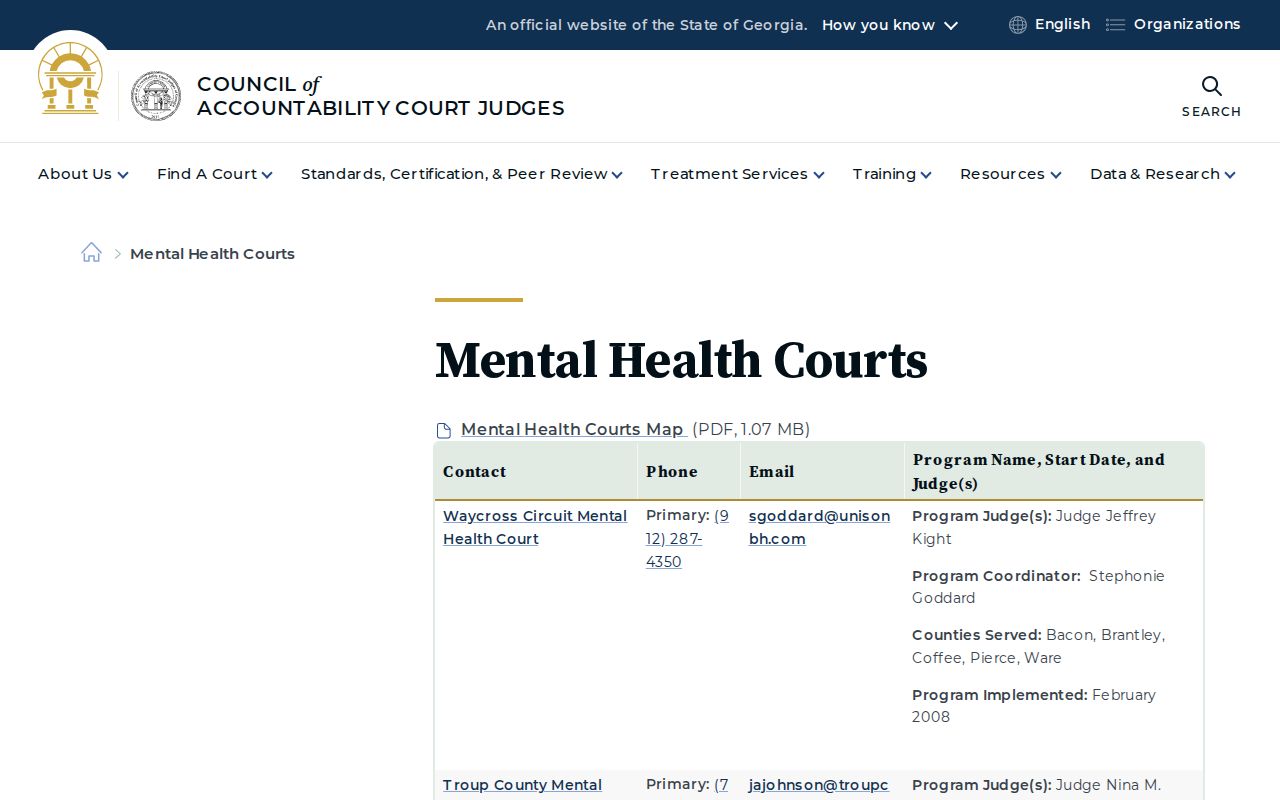
The named track is on the list. Still, verify a participant's setting with the program or Superior Court, since no general program calendar is published.
Access Rules for Criminal Dockets
Uniform Superior Court Rule 21 presumes ordinary Superior Court records are open. A law or court order can limit access. Public does not mean anonymous, free, online, or unredacted. Juvenile files, adoptions, protected identifiers, victim information, and anything sealed by statute or order can be withheld. A gap in your search has many innocent causes. You may have queried the wrong court. An old paper file, a name variation, or your account's scope could also be the reason.
Georgia criminal-history restriction and the court's own case file are related but not the same thing. A change in one system will not automatically erase every docket trace. Parties and their counsel may enjoy rights the public does not. Some requesters need a court order to proceed. The clerk can explain how to make a request, but the clerk cannot give legal advice about access.
Key Rules:
Uniform Superior Court Rule 21 supports public inspection unless law or a tailored sealing order limits it.
O.C.G.A. § 15-5-112 provides a specialized process for qualifying protected persons to restrict specified personal information.
Juvenile Court records follow special confidentiality rules and should not be expected in a general public criminal search.