
Brantley County Court Record Requests
Begin with the basics: which court, what case class, and which item you want. Where you go depends on that answer. Superior and Juvenile files route to Suite 200. Magistrate matters go to Suite 300, and Probate matters to Suite 100. City cases stay with the clerks in Nahunta and Hoboken. Need help locating a Superior case? The E-Access provider covers that. GSCCCA also lets you search its covered database for free. That works at any Georgia Superior clerk office. One limit to remember: no official Brantley source promises email or drop-box requests.
- Use the Brantley County docket search to locate the exact court, case number, document title, and filing date.
- Ask whether the image is available through the authorized provider or courthouse database.
- Call the custodian to confirm custody, access, current fees, payment, and turnaround.
- Visit the correct suite, or mail a focused request when staff approve that channel.
- Choose inspection, plain copy, or certified copy and state a cost limit.
- For Superior Court fax requests, confirm acceptance before sending to 912-462-6247.
You have several distinct channels here. The Georgia E-Access directory, the PeachCourt provider workflow, a phone call, the clerk counter, mail, and the free courthouse database each work differently. Georgia's Open Records Act is a separate law. It is not the request framework for a judicial case file.
Docket, Document, and Certified Copy
Think of three separate products. The docket is the chronological index of a case. A filed document is the actual paper behind an entry, whether a complaint, motion, order, or judgment. A certified copy carries the clerk's attestation that it is true. Reading the word “Order” on an online line tells you nothing about the judge's reasoning. A downloaded provider image may also lack certification.
- Docket or case history
- Dated register of events, settings, and outcomes.
- Filed document
- The actual paper accepted into the case file.
- Plain copy
- A reproduction without clerk certification.
- Certified copy
- A clerk-attested reproduction used when official authenticity is required.
Ask for the narrow product that answers your need. That keeps cost and retrieval work focused.
Kinds of Brantley County Court Records
What you can get depends on the court, the case, its age, and any restriction. A Superior civil file might hold a complaint, service return, answer, motions, notices, and orders. It can also carry a judgment, dismissal papers, and appeal documents. Criminal files often include charging instruments and bond entries. Motions, settings, the disposition, sentence, and appeal entries may appear too. Magistrate records cover small claims, dispossessory actions, warrants, and preliminary proceedings. Probate handles estate and guardianship files plus assigned traffic matters. City ordinance and citation cases sit with the municipal clerks.
- Docket or case history
- Pleadings, motions, notices, and service papers
- Orders, judgments, dispositions, and sentences
- Public exhibits still held by the custodian
- Plain or certified copies of accessible items
Transcripts work differently. Contact the court reporter through the assigned judge's office to ask about availability and cost. Exhibits may carry special custody, retention, or sealing conditions.
The Brantley Suite 200 Request Checklist
A well-built Superior request includes the exact case number if known, the case style without needless sensitive data, the approximate filing year, and the document title and date. Say whether you want certification. Add your delivery method, contact details, and a not-to-exceed amount. These are practical identifiers, not a claimed mandatory Brantley form.
Brantley County Clerk of Superior Court
234 Brantley Street, Suite 200
Nahunta, GA 31553
Mail: P.O. Box 1067, Nahunta, GA 31553
912-462-5635
Fax: 912-462-6247
Monday through Friday, 8:00 a.m. to 5:00 p.m.
Debbie Sirmans is the elected clerk identified by GSCCCA. Her office splits criminal, civil, juvenile, and real-estate work across separate staff, so name the case class when you call.
Brantley Court Records: What They Contain
Read the file alongside the docket. Dates and role labels tie each document to the case. Exact fields vary by court and provider.
| Header | Case number, court, style, filing date, type, and status. |
|---|---|
| Parties and counsel | Public role labels and attorney appearances. |
| Event register | Chronological filing, service, motion, order, and setting entries. |
| Settings | Calendar events and later resets, subject to court confirmation. |
| Outcome | Judgment, dismissal, plea, verdict, sentence, or other disposition. |
| Restriction markers | Sealed, confidential, redacted, or access-limited material when displayed. |
A filed motion is not a granted motion. Match it to a later written order. In the same way, disposed is only a status, not a synonym for conviction or civil judgment.
Why Digital Filing Did Not Move Custody
PeachCourt is mandatory for Brantley Superior civil e-filing. That electronic transport does not make the vendor the official custodian. Georgia's statewide modernization FAQ says the same thing. Judicial records stay separated by court, and neither the AOC nor a vendor becomes custodian. The physical layout at 234 Brantley Street reflects that separation. For copies that prove themselves, the GSCCCA eCertification explanation describes tamper-proof electronic certified copies.
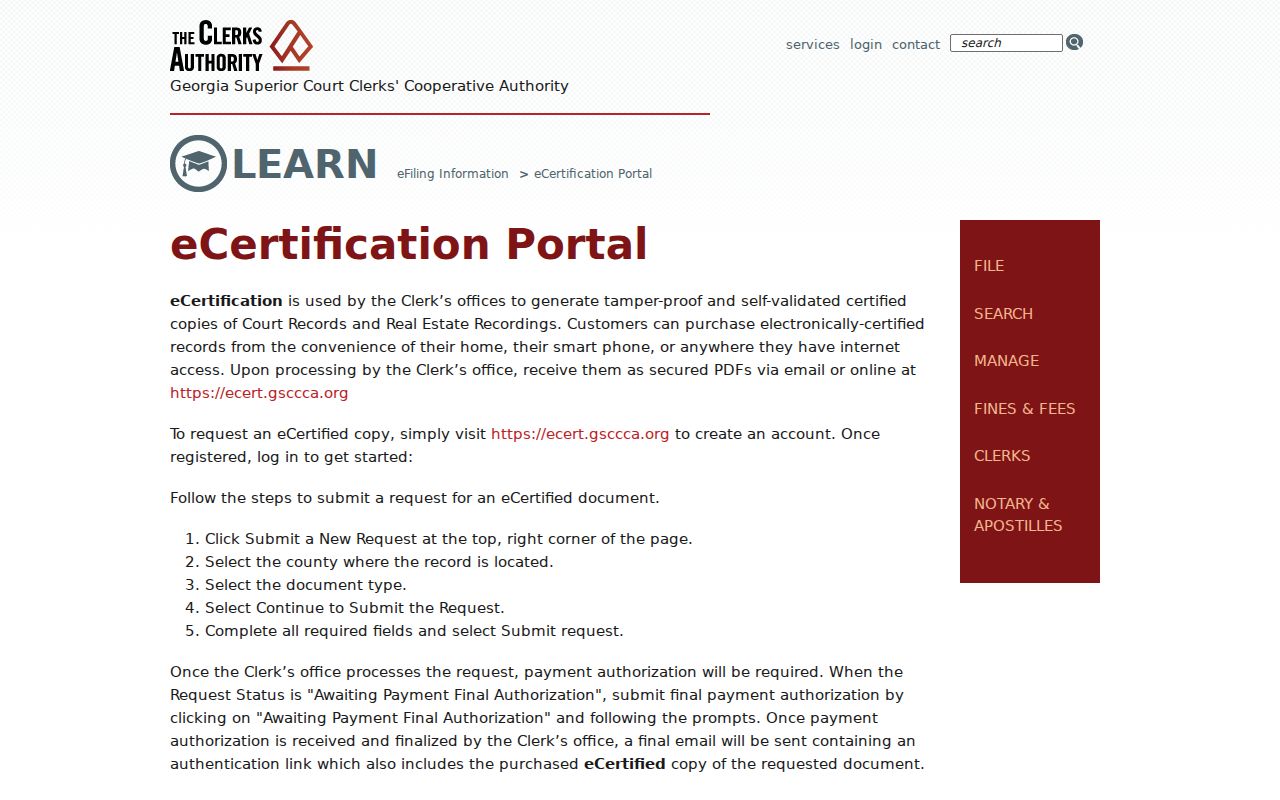
The county list does not confirm Brantley's participation. Ask the clerk before promising that an online certified request can be completed.
Copy Fees and Certification
Brantley official sources publish no comprehensive case-copy price sheet. Do not substitute PeachCourt document charges for clerk fees. Ask whether a base certification charge, per-page charge, retrieval fee, or prepayment applies, and get a total before you buy.
| Item | Published Brantley amount | Action |
|---|---|---|
| Courthouse GSCCCA database inspection | Free | Printing may differ. |
| Plain case-file copy | Not located | Ask the custodian. |
| Certified copy | Not located | Confirm base and page charges. |
| Exemplified copy | Not located | Confirm availability. |
| Archive or retrieval work | Not located | Request a quote. |
| Provider document image | Vendor pricing applies | Not a clerk certification fee. |
A plain copy may be enough for reading or personal organization, which avoids needless certification. When an agency or legal process requires official proof, ask what type of certification it will accept.
Older Brantley County Court Records
An older file may be onsite, archived, transferred, or microfilmed. It could also be lawfully destroyed under the judicial retention schedule. There is no reliable Brantley digitization start date or courthouse-loss history. Give the clerk a year range, the court, and the case type. Include names and the number if you have it. Ask about retrieval time and cost before traveling. Provider guidance that many courts have dockets from roughly 2005 is not a coverage warranty. The clerk's inventory and the official retention schedule control.
Older civil records can also carry civic history. Brantley was created in 1920. The county seat moved from Hoboken to Nahunta in 1923. That history does not prove any particular file survived or was destroyed.
Access Rules for Brantley Court Records
Uniform Superior Court Rule 21 makes Superior records public. Access narrows only when a law or proper order limits it. Rules 21.1 through 21.5 require the scope, nature, duration, and reason for any limitation. Rule 21.6 and Georgia law address protected identifiers. Juvenile files, adoptions, victim information, protected identifiers, and sealed portions can remain unavailable.
Key rules: Uniform Superior Court Rule 21 governs public inspection and sealing of Superior files. The Georgia Attorney General's Open Government resource explains that courts are not subject to the Georgia Open Records Act. Judicial files follow court rules and custodian procedures.
Public does not mean anonymously downloadable, free to print, or unredacted. A docket line may stay public while the exhibit behind it stays restricted. Seek access from the custodian, and get a certified copy when authenticity matters.
Brantley County Request Follow-Through
Before you pay anything, have the clerk's office confirm three things. The document is public. The office actually holds it. The quoted fee covers the certification you need. Leave out protected identifiers when you share your contact details. If staff come up empty, check the court, the name spelling, the year, and the case class again. One more catch matters here. The Superior Court provider covers Brantley County. Even so, a municipal or Magistrate file will not surface there.
Once the copies arrive, line them up against your request: the case number, caption, filing stamp, document date, page count, and certification. An electronic certification should be checked through its own official authentication channel. Ask the recipient whether exemplification is required before you order. The clerk can supply the official record. Choosing which document proves a legal claim is not the clerk's job.