
Brantley County Civil Docket Searches
For a Superior civil case, begin with the Georgia Courts E-Access directory. Pick "Brantley Superior" and plan on creating a provider account. The exact case number works best. A party name can help too. But check the court, year, case type, and party roles before trusting a match. The state page only routes users there. It cannot search every Brantley civil court at one time.
Magistrate Court, at 912-462-6780, keeps the small claims and dispossessory files. Probate Court, at 912-462-5192, holds estates and guardianships. A Superior search that comes up empty does not rule those records out. Older paper files may take a phone call, a counter visit, or a written request. For name-and-number checks across courts, see the broader Brantley docket search.
- Choose Superior, Magistrate, or Probate based on the claim.
- Search by exact case number or an authorized party-name field.
- Match the case type, year, and party roles.
- Read service, motions, settings, orders, and judgment in date order.
- Ask the proper clerk for the actual paper or certified copy.
PeachCourt and Brantley Civil Dockets
Under the current state chart, PeachCourt is mandatory for Brantley Superior civil e-filing. Think of it as the pipeline that moves papers into the court system. It does not become the record keeper, and it does not make every image free. Vendor help lets you pick the county and court. Then search by exact case number or party name. Complaints, answers, motions, notices, orders, and dismissals may all be there. What you can see varies by case, though. The PeachCourt account page shows the gate used for both filing and access.
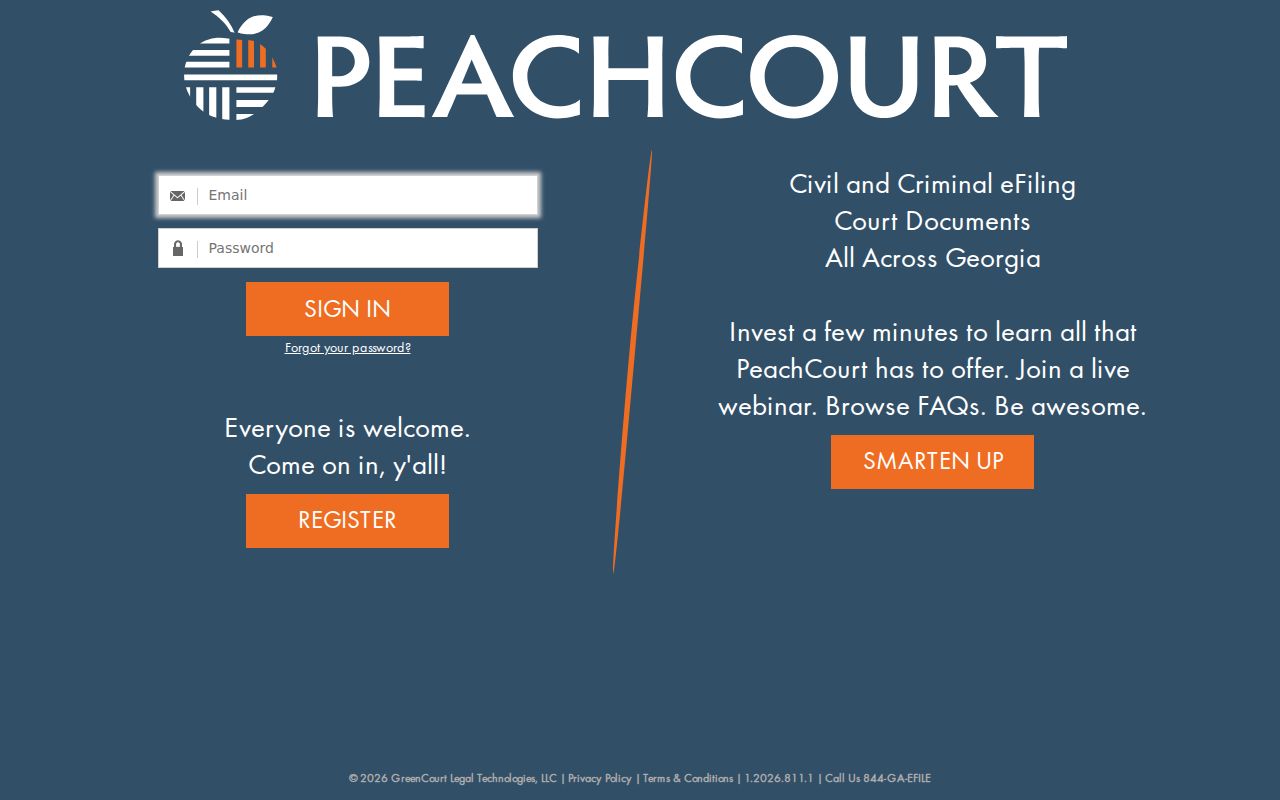
That account interface is only an access point. A certified Brantley civil record still comes from the court clerk.
Brantley Civil Dockets: What They Show
A Brantley civil docket is a dated index of a lawsuit or proceeding. It names the case and the party roles, then logs the complaint or petition, summons, service returns, answers, motions, settings, orders, judgment, and any later enforcement or appeal. Treat these fields as a reading checklist rather than official provider labels.
Party roles matter when you read it. A plaintiff starts an ordinary claim. A defendant responds. Petitioner and respondent appear more in domestic or special proceedings. The complaint or petition opens the case. An answer replies. A return of service records an attempt to deliver formal notice. Read the labels in order, since the same name can sit beside several events without explaining what each one did.
| Case Number | Keep the Brantley identifier exactly as printed; no public local syntax was verified. |
|---|---|
| Parties | Plaintiff and defendant, or petitioner and respondent, each with a distinct role. |
| Filings | Petition, complaint, service, answer, exhibits, notices, and other filed papers. |
| Motions | Requests for court action, followed by separate orders when the judge rules. |
| Judgment | Final judgment, dismissal, or another outcome, plus later enforcement or appeal entries. |
Read Brantley Civil Docket Service
A default entry makes little sense without service history. Find the summons or citation and the return of service first. The return shows whether and how service was attempted or completed. Then look for the answer deadline and any answer filed. Only after that should you interpret a default posture or a default judgment. One line rarely tells the whole story.
A filed motion is just a request. Match it to a later order. If the docket says "Order," you may still need the actual document. That paper tells you what was decided. Ask the clerk for it when the provider shows no image. Protected financial, medical, and identifier content can be withheld. Even then, the rest of the docket stays public.
What Fills Brantley Civil Dockets
"Civil" spans several Brantley record systems. Superior Court has general civil jurisdiction. It also holds exclusive classes like divorce, equity, and title to land. Magistrate Court handles civil claims up to Georgia's statutory limit, generally $15,000. Dispossessory matters sit there too. Probate Court keeps estates and guardianships. Choose by remedy and amount instead of sending every noncriminal matter to Suite 200.
Case type also shapes a document request. A Superior file may run long with pleadings, discovery notices, motions, and orders. A Magistrate claim can move fast. It runs from claim through service, answer, hearing, judgment, and enforcement in short order. A Probate file may hold notices and orders beside protected material. Name the class when you call so staff can route your question quickly.
- General civil, equity, and title-to-land matters in Superior Court.
- Divorce and domestic-relations proceedings in Superior Court.
- Small claims within the Magistrate Court limit.
- Dispossessory cases kept by Magistrate Court.
- Estate and guardianship proceedings kept by Probate Court.
Brantley Civil Dispossessory Dockets
A dispossessory case does not begin at the Superior civil desk. It just involves property. Brantley Magistrate Court keeps those matters at 234 Brantley Street, Suite 300. Call 912-462-6780. Ask for the case number, the service status, answer or hearing information, and how to inspect or copy the file. The Brantley County court directory places Superior, Probate, and Magistrate in three numbered suites.
The directory makes the custody split plain. One building does not mean one civil docket or one clerk for all Brantley cases.
Brantley Civil Docket Hearings
A Brantley civil setting can take many forms. Motion hearings, pretrial conferences, trials, final domestic hearings, dispossessory hearings, small-claims hearings, and probate hearings all appear on the calendar. A notice only puts the event on the schedule. So write down the date, time, courtroom, judge, and setting type before you rely on it. Then watch the docket for a later reset or order.
One caution matters here. A chronological docket can still show an old setting even after a new date appears. The newest operative notice normally controls, but confirm any conflict with the court itself. The Waycross Circuit posts no standalone calendar and sends date questions to the county clerk. A continuance request is just a request, not a granted continuance. Before you drive anywhere, run through the Brantley County court schedule workflow.
Keep the hearing notice beside your docket search result. Compare the case number on both. Ask whether the listed time is a calendar call covering many cases. Or ask whether it is a hearing set for your case alone. Confirm the courtroom, and confirm whether attendance is in person or remote. Brantley offers no countywide reminder program. So a party should not sit back and wait for an alert that may never come.
GSCCCA Index Is Not Brantley Civil Dockets
The GSCCCA search landing page centers on statewide clerk databases like the real-estate and UCC indexes. They can matter for a property question. They are not a civil lawsuit docket, though. A missing property-index result proves nothing about whether a Brantley civil case exists. The GSCCCA search page lays out the scope of those indexes. See the difference yourself.
For an actual lawsuit, go to Brantley Superior through E-Access and its provider. Or contact Magistrate or Probate when jurisdiction points that way. GSCCCA states its covered data can be accessed free at Georgia Superior clerk offices. Free access does not merge distinct court files. Treat each court's records as its own.
Certifying a Brantley Civil Docket Judgment
A docket line that reads "Judgment" is just an index entry. The filed judgment is the real court document. Certification adds the custodian's attestation to it. For Superior Court, call the clerk at 912-462-5635, visit Suite 200 at 234 Brantley Street, or mail a precise request to P.O. Box 1067, Nahunta, GA 31553. Use fax 912-462-6247 only after staff accepts that route.
Give the clerk the case number, style, year, and the document title or date, plus the certification you want. Ask for a quote first, because Brantley posts no complete fee sheet for case copies. A vendor's price is not a clerk certification charge. A Magistrate or Probate judgment must be requested from that court rather than the Superior clerk.
Older files raise their own questions. Ask whether the record is onsite, archived, transferred, microfilmed, or kept only in another lawful form. Then give an approximate year plus the case type. A narrow request tied to one docket entry and document date works far better than a broad demand. Transcripts are a separate matter entirely. The court reporter supplies them, not the docket clerk. The reporter gives the estimate.
Who Sees Brantley Civil Dockets
Uniform Superior Court Rule 21 presumes ordinary Superior records are open. Law or a tailored order can limit access. Public status does not promise a free download or an unredacted image. Domestic cases can mix public docket data with protected identifiers. Juvenile, adoption, medical, and financial material may carry added limits.
Rule 21 requires any limit on Superior access to state its scope, nature, duration, and reason. That does not let someone pluck a sensitive paper from the file on request. The court applies the law and any specific order. Identifier rules may redact a field. Neutral docket events may still be available for inspection. Ask the custodian which public portion can be viewed and what copy method is offered.
One state-level point rounds this out. The Georgia Attorney General states a simple point. Superior, State, Probate, and Magistrate Courts are not subject to the Georgia Open Records Act. A judicial file request follows court rules and the custodian's process. It does not follow the Act's three-business-day framework. When a result is absent, check the court. Check the spelling, the year, the account scope, and the paper storage too. Do not assume the file is sealed until then.
Key Rules:
Uniform Superior Court Rule 21 supports inspection unless law or a tailored order restricts it.
Georgia Open Government guidance distinguishes judicial court files from ordinary agency records.
Protected identifiers and sealed material may be withheld while the rest of a civil docket stays open.